Tagged Learning targets
Visual to Text Literacy: Using Engaging Images for Metacognitive Gains

This is the image used in Tim Starkey’s lesson. Created by Robert and Shana ParkeHarrison and available at this link:
http://parkeharrison.com/architect-s-brother
For a moment, ponder and name the thinking skills involved in comprehension of material.
Regardless of the content, you might have come up with ideas like: gathering observations, making connections, and asking meaningful questions among other things.
These are all strategies teachers use for reading comprehension, and although students might be exposed to these types of thinking regularly, do they really understand what they are doing or why?
The “Extended Looking” lesson I have been using in teachers’ classrooms addresses the metacognitive skills needed to build comprehension through two methods:
1. Exposing them to the explicit language of comprehension so they may use these skills consciously in the future for other purposes.
2. Providing practice with these strategies to build confidence for future endeavors.
Here are the learning targets for the Extended Looking lesson I used in Tim Starkey’s class last week.
- I can observe closely and critically.
- I can actively listen and contribute meaningful ideas to a conversation that results in deeper learning for others and myself.
- I can ask meaningful questions to help to drive dialogue.
- I can write a statement supported by evidence that reflects a deep understanding of a theme.
I have posted about this activity previously, but I have expanded on the resources and applications for teachers. Here are the materials I provided to Tim Starkey when we used the Extended Looking method in his AP 12 classroom (These are also provided as a downloadable copy in the attachments at the end of this post):
_____________________________________________________________________________________________________________________________
Extended Looking Lesson Instructions
*Note: timing on this is tentative and depends upon the class and the conversation.
- Review and discuss the learning targets
- Put the image on the overhead. Ask students to look closely at the art – you can move around, get closer etc. Write down observations and try to list at least ten (5 min.)
- Prompt students to “keep looking” even when they think they are done
- Ask them to begin with the obvious and then look closer for the details
- Consider textures, colors, posturing of figures etc.
- Discuss the visual image. What is happening in the photo/image? Here you are noting details and making observations, no talk of meaning yet (5 min)
- Recognize and label “meaning statements” and then redirect back to gathering evidence
- Explain that gathering evidence ultimately leads to better conclusions
- Make connections to and ask questions about the art in writing. What are your thoughts about the piece, what does it remind you of, can you connect it to anything etc. (5 min.)
- Prompt students to consider text, image, film, music and personal connections
- Prompt students to ask meaningful questions that help their peers to think deeper into the image
- Discuss the connections/questions students found in the piece and continue to have students use the evidence they have gathered to support their perspective (5 min.)
- At this point begin asking, “What makes you say that?” Seek to help students explain their perspective; ask them to point back to the evidence in the image when possible
- Possibly write these on the board (or have a student do this) so that everyone has a visual.
- Introduce and model a theme statement for students. Have students write a “theme statement” for what they think the piece of art means and support it with evidence from the art itself (10 min.)
- In this context, the theme formula is: Topic + Opinion; another way to say this is what is the piece about (in a single word) what is the author/artist trying to say in regard to this topic
i. EX: Topic (creativity) + Opinion (it leads to alienation when ideas are “before their time”)
ii. Theme Statement: Creativity can lead one to be alienated when his or her ideas are not yet accepted or recognized by those around them because they are too forward thinking.
- Collect these to formatively assess students learning of the objectives
- Optional: On a different day, tell them the name and a little about the artist. Does this change your perspective on the piece? Are you glad you know? (They usually are not.)
- Reflect: What surprised you about this activity? What did you learn? How does it relate to ELA and to reading specifically? What skills did you practice? How will you use them in the future?
- This is a very important aspect of the activity. Students have to have time to recognize the learning that has taken place and ponder how it will apply to the tasks they are being asked to do in the future.
- This would be an excellent place to discuss and compare where students gained and where they did not to guide future instruction as well.
___________________________________________________
Extensions
- Before step five, have students write short form poetry about the art or a piece of narrative
- Talk about the process of how the art was created and use it to model students own work in writing after the activity
____________________________________________________
Connections to help students make during the activity
(and especially during the reflection)
- Literature and visual art are very similar and we can talk about them the same way and go through the same process of analysis with them
- An artist or writer has an intent, but viewer/reader also bring their own experience to the table to create “meaning;” however, whoever’s meaning it is, it must be supportable with evidence, and it must be logical for anyone else to trust or understand it. (This is relevant to literary analysis and argumentative writing.)
- Students can help one another learn by building on thoughts and ideas. This can help to clarify thinking as well.
- These processes: observation, making connections and asking questions and building meaning (individually and collaboratively) are processes that are used outside of the classroom. They are problem solving and thinking processes used in every field from science to art.
___________________________________________________
Probing questions/statements for the teacher
- What makes you say that?
- Can you show me where you see that evidence (ask them to come to the image)?
- Do you all agree with this idea?
- Does anyone disagree with this idea?
- What else do you see?
- That is an interesting idea. Can you tell me more about…
_____________________________________________________________________________________________________________________________
Teacher Resources:
- Burning Season Architects Brother- Power Point with Learning Targets and the Image “Burning Season”
- Extended Viewing Strategy This is a the resource posted in the blog (above)
- Extended Looking Learning Targets and Reflection– This is a resource to give to students at the beginning of the lesson. It will also be referred to again at the end of the lesson as students track their own progress toward the learning goals and reflect on growth.
Extended Looking: Using Images to Build Theme Statements
I worked with Kristina Claytor and Allie Sberna this week using a strategy learned/modified from the Pages program at the Wexner Center. This learning activity is one I have utilized many times, and it was a pleasure to work with two patient, flexible and talented teachers trying it out with a new group of students who are learning to “look deeper” and explore thematic connections.
The “product” of the strategy is the creation of a single sentence theme statement that is supported by multiple pieces of evidence from an image students have studied. Here is the image from which students gathered information.

This image is from Robert and Shana ParkeHarrison. Here is a link to the original image online.
Here are the learning targets provided to students:
- I can look carefully and critically.
- I can contribute meaningful ideas to a collaborative conversation.
- I can write a theme statement that reflects a deep understanding of a theme.
I usually introduce themes to students as topics (or “big ideas” if you prefer) plus an opinion about that topic. Here are some of the “big ideas” or topics students were able to come up with using this strategy:
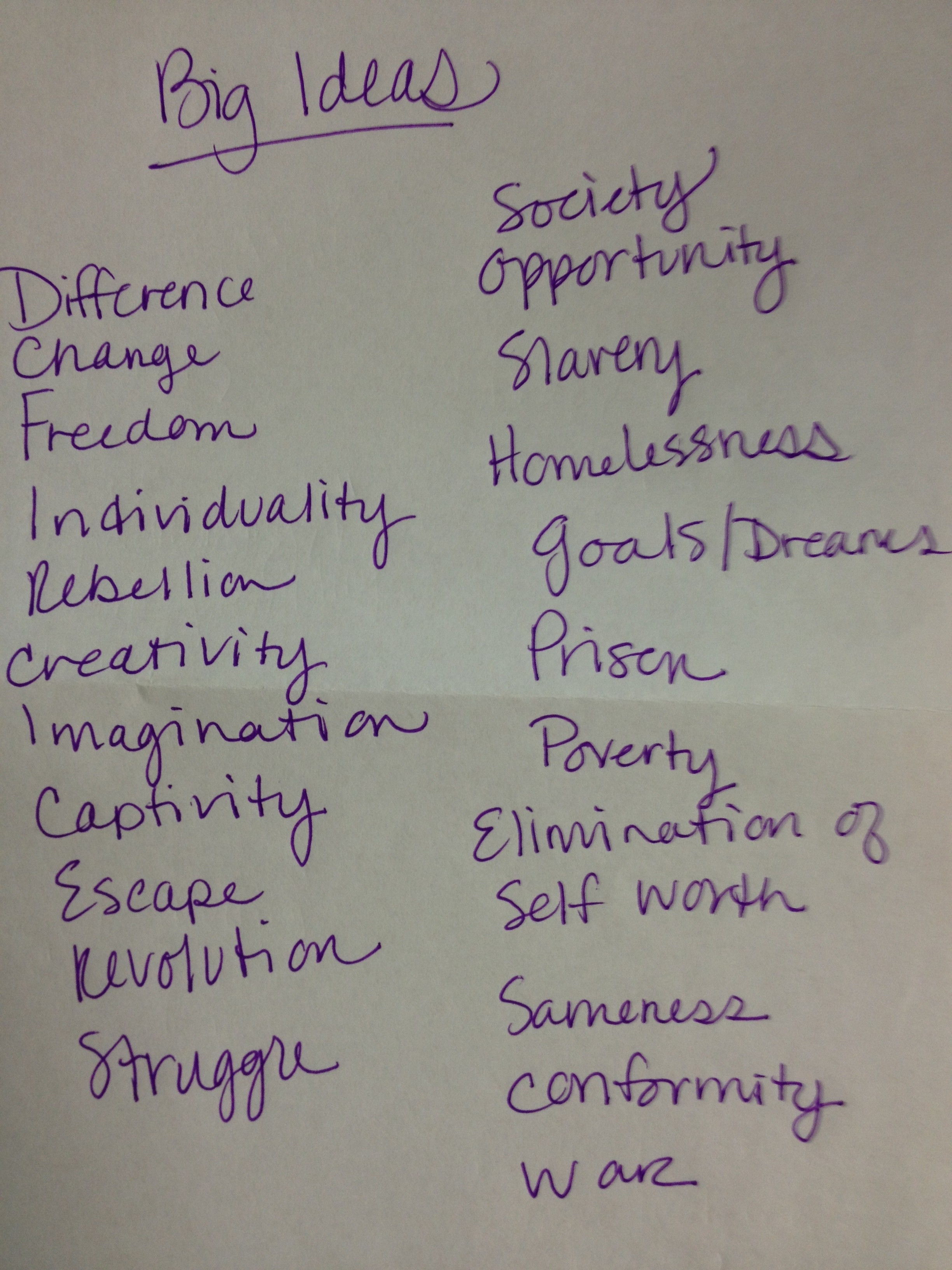
We explained a theme is one of these big ideas/topics above, plus what they think an author/artist is saying about this topic (his/her opinion).
Example: Topic (Creativity) + Opinion (can require seeing/doing what others may not yet understand).
So a theme statement might be: Creativity can require seeing and doing what others may not yet understand.
Students might support this theme statement with evidence from the text by saying that, “The man represents creativity because he is the only one ‘seeing’ what is in the distance, so he is the only one willing to escape the box. The others remain curled in the containers because they don’t believe in or have knowledge of this new understanding.”
This is a very difficult concept for students; it takes practice. They may have to look back at and revise the theme statements after the teacher collects them and gives feedback. However, this is also an essential skill for literary response.
The following is a handout I have given to teachers to explain the activity step by step. I have also attached the instructions as a downloadable document at the bottom of the post.
Extended Looking Activity: Learning Goals
This lesson is a scaffolding tool to help students understand theme in literary works. The learning goal is to have students be able to write a “thesis statement” for what they think the piece means; they must base it on evidence they have gathered from the piece itself.
____________________________________________________
Extended Looking Instructions
- Look and observe the art – you can move around, get closer etc. Write down observations and questions about it (5 min.)
- Discuss the visual image. What is happening in the photo? Here you are noting details and making observations, no talk of meaning yet (5 min)
- Make connections to and ask questions about the art in writing. What are your thoughts about the piece, what does it make you think of, does it remind you of anything etc. (5 min.)
- Discuss the connections students found in the piece and continue to have students use the evidence they have gathered to support their perspective ( 5 min.)
- Introduce and model a theme statement for students. Have students write a “theme statement” for what they think the piece of art means and support it with evidence from the art itself (10 min.)
- Tell them the name and a little about the artist. (I do this the next day and build suspense!) Does this change your perspective on the piece? Are you glad you know? (They usually are not.)
Extensions:
- Before step five, have students write short form poetry about the art or a piece of narrative
- Talk about the process of how the art was created and use it to model students own work in writing after the activity
Connections to help students make:
- Literature and art are very similar and we can talk about them the same way and go through the same process of analysis with them
- An artist or writer has an intent, but viewer/reader also bring their own experience to the table to create “meaning”
- This activity shows how argument is developed because students needed to use support for their ideas
This activity was modified from the 2011-2012 PAGES summer workshop for teacher-partners at the Wexner Center, and photography used to conduct the activity was created by Robert and Shana ParkHarrison from The Architect’s Brother collection.
Here is the printable resource Extended Viewing Activity 2
Learning Targets- Tracking Sheets and Examples
What does Ben Baptiste love?
…learning targets! Just ask him about it. : )
He was one of many teachers to have them posted in both of the schools this week when I visited classrooms.
Here are some examples of targets I saw.

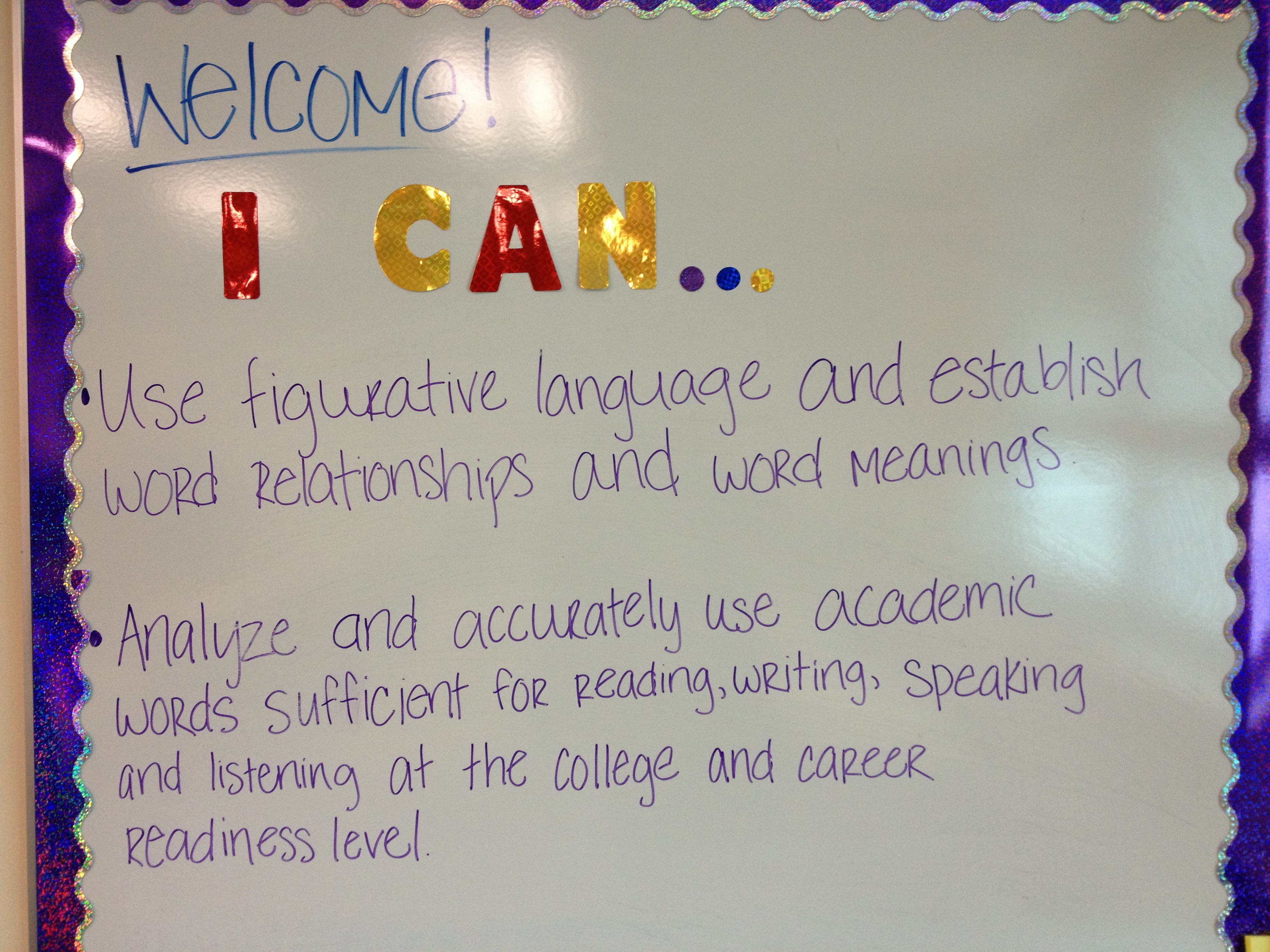

Here are two tracking sheets I created for students to record the learning targets for a unit. The idea behind them is that students would attach all of the “evidence” of the targets to the sheet for teachers as part of a formative assessment.
There is also a tracking sheet for the teacher to use at the end of units as a reference.
 Learning Lab Consulting