Tagged Brene Brown
Q and A: Writer’s Workshop at the ESC of Central Ohio
On November 9, I facilitated a Writer’s Workshop at the Educational Service Center. Below you will find the Q and A and some resources I use for the event.

During the workshop, we defined the importance of environment for the vulnerable work of sharing our writing together. The qualities the group determined were most important were: Courage, Purposefulness, and Respect, affectionately given the acronym CPR.
To begin, here is a link to the Power Point used in the workshop. In addition, here are other resources you may find helpful:
- Overview of writers workshop (handout)
- Writer’s workshop coaching sheet
- Writer’s workshop note taking sheet
- Writers workshop revision record
Also, here are the TEDTalks from Brene Brown on vulnerability and shame that I mentioned.
A (Sappy) Love Song to My Friends

Mel and I wishing our friend Renee good luck on a concert via text.
In the words of C.S. Lewis in Four Loves:
Friendship arises out of mere Companionship when two or more of the companions discover that they have in common some insight or interest or even taste which the others do not share and which, till that moment, each believed to be his own unique treasure (or burden). The typical expression of opening Friendship would be something like, “What? You too? I thought I was the only one.” … It is when two such persons discover one another, when, whether with immense difficulties and semi-articulate fumblings or with what would seem to us amazing and elliptical speed, they share their vision – it is then that Friendship is born. And instantly they stand together in an immense solitude.
And so is the beginning of a journey together.
I remember quite vividly and with great reverence my first best friend. I was in seventh grade when we met. The first time I went to her house a few weeks later, we walked to a creek and searched for rocks that we could wash and admire together. It was with great relief and surprise that I realized I had found a kindred spirit- a lover of rocks and the magic of the world to give them to us.
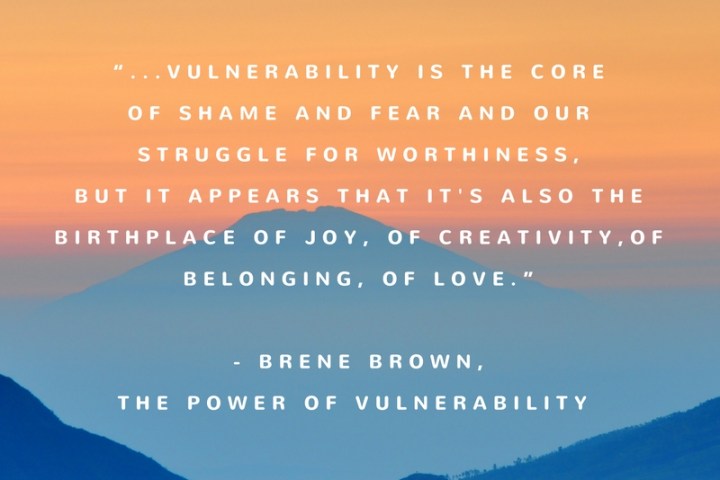
Vulnerability: “The Birthplace of Innovation, Creativity and Change”
“Don’t approach your history as something to be shaken for its cautionary fruit… Tell your stories, and your story will be revealed… Don’t be afraid of appearing angry, small-minded, immoral, amoral, calculating or anything else. Take no care for your dignity. Those were hard things for me to come by, and I offer them to you for what they may be worth.”
–Lit, Mary Karr’s memoir documenting her struggles as a young wife, mother, and poet
A few weeks ago, PHSN had poets Ethan Rivera, Rachel Wiley and Hanif Abdurraqib visit to share their spoken-word poetry and talk about their inspiration and writing process. (I will try to get some of this work on the blog as a video as soon as I can overcome the technical difficulties I am having with my ipad.)
Many of the poems presented were very personal. Abdurraqib discussed watching members of his family suffer with depression, Rivera shared lamenting the loss of a high school sweetheart on her wedding day, and Wiley read works exploring how the designation of “fat” has been a struggle for her throughout her life, including how at one point an audience member went as far as to send her a critical letter shaming her after she read a work about body image. (She later read a poem in response while he was in the audience.)
The honesty and human connection in these moments was hard to deny. As an audience member, it was easy to feel the pang (or cringe) of recognition in the stories and poems shared. This is not uncommon; each of the poets described the “connection” between the reader and audience as a major reason they take the emotional risk of stepping on the stage each time- even when it is one of the most difficult things one can do (especially in the early years of performing).
I can relate to this, and I am sure many students, teachers and writers can as well; creative writing is personal. Poetry exposes feeling. Narrative shares life and perspective.
However, the reward for being consciously vulnerable in order to build a connection with others can’t be underestimated as a tool for growth and development. Writing, and sharing writing, is a way to facilitate this growth.
Brené Brown spent over a decade of her life researching what makes individuals “happy” and mentally “healthy.” Her first TEDTalk was about the ability to be vulnerable and take emotional risks in order to find these things. It got millions of views and can be seen here.
Conversely, she also found that “shame,” or the inability to share meaningfully of ourselves with others, is the root of many people’s unhappiness. She shares these findings in a second TEDTalk focused on what holds people back from finding the things they seek. It can be seen below.
In her second TEDTalk, she begins by talking about the aftermath and “vulnerability hangover” that resulted from her first talk. She also discusses the speaking engagements in which she was asked to participate afterward,
“One of the weird things that’s happened is, after the TED explosion, I got a lot of offers to speak all over the country — everyone from schools and parent meetings to Fortune 500 companies. And so many of the calls went like this, ‘Hey, Dr. Brown. We loved your TEDTalk. We’d like you to come in and speak. We’d appreciate it if you wouldn’t mention vulnerability or shame.’ What would you like for me to talk about? There’s three big answers. This is mostly, to be honest with you, from the business sector: innovation, creativity and change. So let me go on the record and say, vulnerability is the birthplace of innovation, creativity and change. To create is to make something that has never existed before. There’s nothing more vulnerable than that. Adaptability to change is all about vulnerability.”
These goals of industry: innovation, creativity, change, are also goals of education at this time. It only makes sense that as we prepare students for the future, we would align with the economic climate in which they will be entering, and yet, there is more that education can do. Teaching young people is a human enterprise, and beyond preparing for economic success, showing and sharing vulnerability in the classroom through modeling and promoting healthy risk-taking could help to build more well-rounded human beings. This is not easy; exposing one’s thinking process, trying a new activity, being comfortable not knowing the answer, or modeling writing and process can feel uncomfortable. Nevertheless, while creating happier and healthier people might not be the primary job of the educational system, it is surely the primary goal of those who value humanity and its potential.
 Learning Lab Consulting